








How AI is Revolutionizing EMI Testing: Boost Efficiency and Cut Costs for Engineers
EMI (Electromagnetic Interference) testing plays a vital role in ensuring that electronic devices perform reliably without causing or being affected by interference. It helps products meet safety standards and regulatory requirements. However, traditional EMI testing methods can be slow, complex, and prone to human error, often leading to delays and missed issues that only surface later in the process.
Enter AI, a game-changer in the world of EMI testing. AI-powered tools are transforming how engineers approach this challenge by automating data analysis and frequency scanning. Instead of manually sifting through vast amounts of data, AI processes it in a fraction of the time, quickly identifying potential problems. What’s even more powerful is AI’s ability to predict EMI issues early in the design phase, allowing engineers to make adjustments before hardware prototypes are even built, saving both time and costly revisions.
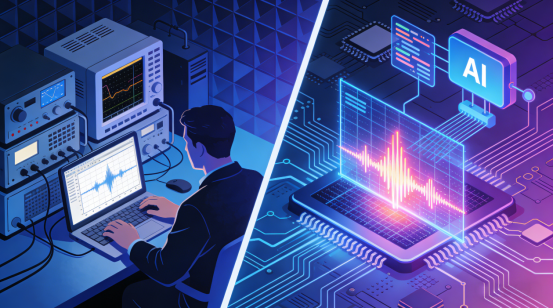
Key Challenges in Traditional EMI Testing
Time-Consuming Manual Analysis
Traditional EMI testing relies heavily on manual data analysis, which is both slow and tedious. Engineers must sift through vast amounts of frequency data, ranging from low MHz to high GHz, to identify potential EMI issues. This process can take hours or even days, depending on the complexity of the device being tested.
Increasing Data Volume: As technologies like 5G, IoT, and electric vehicles become more prevalent, the amount of data that needs to be analyzed grows exponentially, further slowing down the process.
Missed Issues: The risk of missing subtle interference or weak signals increases with manual analysis, which can lead to costly design changes or regulatory failures later in the development cycle.
This inefficiency not only delays the testing process but also increases the risk of overlooked problems that could impact the performance of the device.
Complex Compliance Regulations
Another significant challenge is navigating the various global EMI compliance standards. Different regions and industries have their own specific regulations, such as FCC in the U.S., CE in Europe, and MIL-STD for military and aerospace devices.
Multiple Standards: Each standard has its own set of limits for emissions and immunity, creating a complex web of requirements that engineers must follow.
Frequent Changes: These regulations are not static; they evolve frequently, requiring engineers to stay constantly updated on the latest changes.
Manual Cross-Checking: Engineers must manually compare test results with these evolving standards and generate compliance reports, which adds considerable time and effort to the testing process.
This complexity often results in longer testing cycles and increases the chances of non-compliance, which can lead to product delays or market restrictions.
Human Error and Its Impact on Testing Results
Human error is a constant risk in traditional EMI testing. Engineers may inadvertently misinterpret data, overlook weak signals, or make mistakes during test setup.
Data Misinterpretation: Subtle interference signals might be missed, or noise could be incorrectly classified as real interference, leading to inaccurate results.
Improper Test Setup: Errors like incorrect antenna placement or uncalibrated equipment can skew the test results, wasting time and resources on retesting.
Outdated Methods: As industry standards evolve, engineers may continue using outdated testing procedures, which could lead to missed issues or non-compliance with new regulations.
These errors can delay the development process, require costly redesigns, and in some cases, even result in regulatory fines if compliance is not met.
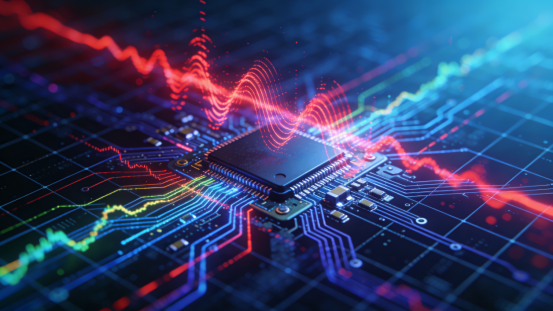
How AI Improves EMI Testing Efficiency
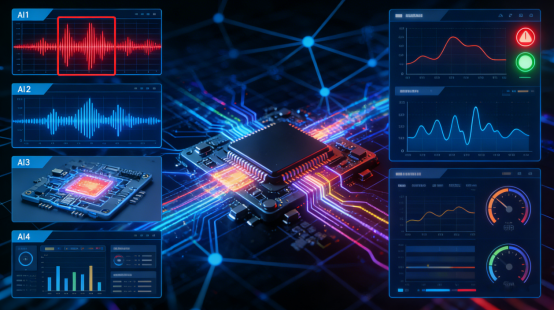
Automated EMI Signal Detection
AI-powered tools are transforming the way EMI signals are detected during testing. Traditionally, engineers manually scan and sort through vast amounts of frequency data to identify interference. This process is slow and prone to human error. With AI, the scanning process is automated, allowing systems to quickly analyze and sort frequencies across a wide range, identifying potential EMI signals almost instantly.
Speed and Accuracy: AI tools can scan thousands of frequencies in seconds, identifying interference patterns with greater precision than traditional methods. This allows engineers to pinpoint issues faster and with fewer false alarms.
Hidden Interference Detection: AI can also identify subtle or hidden interference signals that might be missed in a manual analysis. By learning from historical data and patterns, AI is trained to spot issues that are not immediately obvious.
Predictive Modeling for Early Issue Detection
AI’s predictive modeling capabilities allow engineers to detect potential EMI issues during the design phase, well before physical prototypes are built. This is done by using AI algorithms to analyze the design and predict how it will perform in terms of EMI.
Design Phase Testing: AI tools can simulate how different components will interact with each other and how they might emit or be affected by EMI. These predictions help engineers identify problem areas early, reducing the need for costly design revisions later.
Preventative Approach: Instead of waiting for physical testing, AI helps engineers anticipate and fix EMI problems before they arise, saving both time and money.
Real-Time Monitoring and Instant Anomaly Detection
AI’s real-time monitoring capabilities offer a significant advantage for ongoing EMI testing. While traditional testing only occurs at specific points in the development process, AI continuously monitors signal integrity during operation, ensuring that devices perform optimally at all times.
Continuous Monitoring: AI systems can monitor EMI in real time, detecting anomalies as soon as they occur. This is especially important for devices operating in dynamic environments, such as industrial sensors or communication systems.
Instant Intervention: When AI detects an anomaly, it can immediately intervene by adjusting parameters like signal strength or switching to a different frequency to prevent performance degradation or compliance failure.
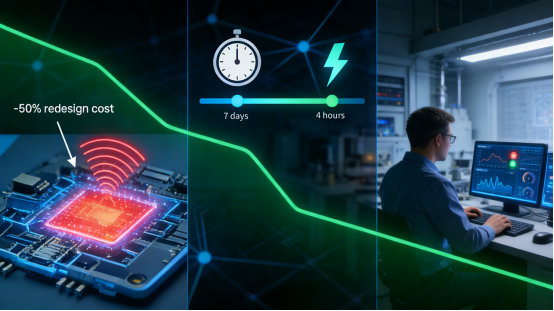
AI’s Impact on Cost Reduction in EMI Testing
Reduced Redesign Costs with Predictive Tools
AI-driven predictive tools are a game-changer in reducing costly redesigns. In traditional EMI testing, potential issues are often discovered late in the development process, sometimes only after physical prototypes have been built. If a device doesn’t meet EMI standards, the team may need to revisit the design, leading to expensive changes and delays.
Early Issue Detection: AI tools can analyze a product's design in the early stages, predicting potential EMI problems before hardware is built. By simulating how components and PCB layouts interact, AI identifies interference risks and suggests design improvements to avoid them.
Cost Savings: Addressing EMI issues early in the design phase is far less expensive than making changes after the prototype is built or production begins. The ability to fix potential problems at this stage can save significant amounts—often between $10k and $50k per redesign.
Shortened Testing Time and Faster Compliance
AI significantly speeds up the entire EMI testing process, allowing companies to move faster through product development and compliance checks. Traditional manual testing can take days or weeks to complete, with engineers spending large amounts of time analyzing data and conducting multiple tests.
Faster Data Processing: AI tools can automatically scan frequencies and detect EMI issues in a fraction of the time it would take a human. These tools use machine learning to sort through vast amounts of data quickly, identifying potential interference in minutes instead of hours or days.
Accelerated Time-to-Market: Faster testing means shorter development cycles, allowing products to reach the market more quickly. This is particularly important in industries like electronics and telecommunications, where being first to market can provide a significant competitive edge.
Minimizing Lab Dependency with AI Tools
Traditionally, EMI testing has required expensive lab setups, often involving specialized equipment like anechoic chambers and third-party testing facilities. These setups can be costly and time-consuming, especially for small teams or startups with limited budgets.
AI for In-House Testing: With AI-powered tools, companies can significantly reduce their dependence on external labs. These tools allow engineers to perform many testing tasks in-house, including real-time analysis and compliance checks, without needing to invest in costly lab infrastructure.
Lower Testing Costs: By minimizing the need for physical lab space and outsourcing to third-party testing facilities, companies can save on both capital investment and recurring testing fees. This can be especially beneficial for businesses trying to keep costs low during the development phase.
Practical Applications of AI in EMI Testing
AI in PCB Design and Layout Optimization
AI plays a critical role in optimizing the design of printed circuit boards (PCBs) to prevent EMI issues. When designing PCBs, engineers must carefully route the traces and place components to minimize interference. Small mistakes in trace routing or component placement can lead to EMI problems that affect the device’s performance.
Optimizing Trace Routing: AI analyzes PCB layouts and identifies areas where traces might cause interference, such as those that cross sensitive components or run too close to power traces. It can suggest optimal routing that reduces EMI by minimizing crosstalk and loop areas.
Component Placement: AI tools can recommend the best placement for components based on their electromagnetic characteristics. For example, AI might suggest positioning high-speed components (e.g., RF modules) further away from noisy components (e.g., power regulators) to reduce potential interference.
Virtual Simulations for EMI Testing
AI enhances virtual simulations, enabling engineers to test designs virtually before creating physical prototypes. System-level simulations powered by AI can predict how a device will behave in real-world conditions, including how it will interact with electromagnetic fields and what potential EMI emissions might occur.
System-Level Simulations: AI uses advanced algorithms to simulate the behavior of entire systems, including PCB layouts, components, and their interactions with external electromagnetic fields. These simulations help predict how EMI will behave without needing to build a physical prototype.
Early Detection: Virtual simulations can reveal EMI problems early in the design process, allowing engineers to make changes before moving to the costly stage of physical testing. AI-driven tools can also simulate different operating conditions (e.g., temperature, voltage) to ensure the product performs well across a range of scenarios.
Workflow Streamlining and Compliance Reporting
AI can significantly streamline the workflow of EMI testing by automating routine tasks such as test setup, data analysis, and regulatory reporting. This reduces the time spent on administrative tasks and allows engineers to focus more on solving technical challenges.
Automating Test Setup: AI tools can automatically configure test equipment based on the product being tested. For example, the system might automatically set up the test parameters (e.g., frequency range, equipment calibration) based on the device type, ensuring consistency and accuracy.
Data Visualization: AI can process and visualize large datasets, turning raw EMI data into easy-to-understand graphs and charts. Engineers can quickly identify problem areas and focus their efforts where needed.
Regulatory Reporting: AI tools automate the creation of compliance reports, ensuring that the necessary data is collected and presented in the required format for certifications such as CE, FCC, or MIL-STD. This speeds up the reporting process and reduces the risk of human error.
Conclusion: Leveraging AI for Smarter EMI Testing
AI is revolutionizing EMI testing by automating data analysis, predicting issues early in the design phase, and enabling real-time monitoring. These advancements help engineers detect problems faster, reduce redesign costs, and improve product quality. Predictive tools identify potential EMI risks before physical prototypes are built, saving both time and money, while real-time monitoring ensures issues are addressed immediately during operation.
Looking ahead, AI will continue to streamline EMI testing, making it more efficient and cost-effective. Engineers can stay ahead of industry trends by integrating AI tools into their workflows. Companies like PCBMASTER, a trusted PCB supplier, are already offering AI-driven solutions to optimize designs and ensure compliance with global EMI standards. With AI, engineers can meet the growing demands of technologies like 5G, IoT, and electric vehicles, ensuring faster, more reliable product development.
FAQs
What is the main advantage of using AI in EMI testing?
The primary advantage of using AI in EMI testing is its ability to drastically reduce testing time, enhance accuracy, and predict potential issues before they occur. Traditional EMI testing is often a time-consuming process, requiring manual data analysis and multiple test iterations. AI tools automate data analysis, allowing engineers to scan thousands of frequencies in minutes instead of hours. These tools also improve accuracy by reducing human errors and false positives, ensuring that only genuine issues are flagged. Furthermore, AI can predict potential problems early in the design phase, allowing engineers to make adjustments before costly physical prototypes are built, ultimately saving time and money.
Can AI completely replace engineers in EMI testing?
No, AI cannot completely replace engineers in EMI testing. Instead, AI acts as a powerful tool that assists engineers by automating repetitive tasks and providing data-driven insights. While AI can handle tasks like frequency scanning, data analysis, and compliance reporting, engineers are still needed to interpret the results, make strategic decisions, and solve complex design challenges. AI helps engineers work more efficiently, enabling them to focus on higher-value tasks like optimizing designs and ensuring that devices meet performance and regulatory standards. In essence, AI enhances engineers' capabilities but doesn't replace their expertise.
How can AI tools help small teams with limited budgets?
AI tools can be highly beneficial for small teams with limited budgets. Many AI-driven solutions, such as cloud-based platforms or entry-level tools, are affordable and scalable, making them accessible for companies without large testing budgets. These tools can significantly reduce the need for expensive lab setups or outsourcing to third-party testing facilities. Small teams can use AI to perform high-quality, automated EMI testing in-house, improving efficiency and reducing costs associated with physical testing. For example, AI can automate compliance reporting and data analysis, tasks that would otherwise require substantial time and resources. By leveraging AI, small teams can compete effectively while keeping costs down.
Is AI effective for high-frequency devices like 5G?
Yes, AI is highly effective for testing high-frequency devices like 5G routers and IoT sensors. One of the key challenges in testing high-frequency devices is managing the complexity of interference at higher frequencies, such as those used in 5G and IoT technologies. Traditional testing methods may struggle to keep up with the speed and volume of data at these frequencies. AI tools, however, can handle the specific demands of high-frequency EMI testing by analyzing large datasets quickly, identifying subtle interference patterns, and making predictions about potential issues. AI can simulate the behavior of these devices at various frequencies and conditions, ensuring that they meet EMI standards even at the highest frequencies.
How do AI tools ensure compliance with global standards?
AI tools help ensure compliance with global EMI standards by automating the testing process to meet industry-specific and regional regulations, such as FCC (U.S.), CE (EU), and MIL-STD (military and aerospace standards). These tools are designed to test devices against a wide range of standards, automatically configuring the necessary test parameters based on the device type and regulatory requirements. AI also streamlines the compliance reporting process by generating reports that meet the required format and include all necessary data, reducing the manual effort involved. This automation helps engineers stay up-to-date with changing regulations and ensures that their products pass compliance tests more quickly and accurately, reducing the risk of delays or non-compliance penalties.
Author Bio
Hi, I'm Carol, the Overseas Marketing Manager at PCBMASTER, where I focus on expanding international markets and researching PCB and PCBA solutions. Since 2020, I've been deeply involved in helping our company collaborate with global clients, addressing their technical and production needs in the PCB and PCBA sectors. Over these years, I've gained extensive experience and developed a deeper understanding of industry trends, challenges, and technological innovations.
Outside of work, I'm passionate about writing and enjoy sharing industry insights, market developments, and practical tips through my blog. I hope my posts can help you better understand the PCB and PCBA industries and maybe even offer some valuable takeaways. Of course, if you have any thoughts or questions, feel free to leave a comment below—I'd love to hear from you and discuss further!